.png)
When We're Running Out of Hope, God is at Work.
“When We’re Running Out of Hope, God Is at Work”
December 7, 2025
Matthew 11:1-11 | Isaiah 43:19-21
Second Sunday of Advent
Matthew 11:1-11
11 Now when Jesus had finished instructing his twelve disciples, he went on from there to teach and proclaim his message in their cities.
2 When John heard in prison what the Messiah[a] was doing, he sent word by his[b] disciples 3 and said to him, “Are you the one who is to come, or are we to wait for another?” 4 Jesus answered them, “Go and tell John what you hear and see: 5 the blind receive their sight, the lame walk, those with a skin disease are cleansed, the deaf hear, the dead are raised, and the poor have good news brought to them. 6 And blessed is anyone who takes no offense at me.”
7 As they went away, Jesus began to speak to the crowds about John: “What did you go out into the wilderness to look at? A reed shaken by the wind? 8 What, then, did you go out to see? Someone[c] dressed in soft robes? Look, those who wear soft robes are in royal palaces. 9 What, then, did you go out to see? A prophet?[d] Yes, I tell you, and more than a prophet. 10 This is the one about whom it is written,
‘See, I am sending my messenger ahead of you, who will prepare your way before you.’
11 “Truly I tell you, among those born of women no one has arisen greater than John the Baptist, yet the least in the kingdom of heaven is greater than he.
Isaiah 43:19-21
19 I am about to do a new thing; now it springs forth; do you not perceive it?I will make a way in the wilderness and rivers in the desert.20 The wild animals will honor me, the jackals and the ostriches,for I give water in the wilderness, rivers in the desert,to give drink to my chosen people,21 the people whom I formed for myselfso that they might declare my praise.
We spend a lot of time in the season before Christmas preparing. And not just in the traditional sense of having the presents wrapped and the cookies baked and the travel plans settled. But also the kind of preparing that gets our community ready to celebrate the birth of Christ.
This week alone we spent a lot of time at church preparing. Last Sunday we made beautiful decorations and Advent wreaths and gifts together at our Advent festival. Afterward, our youth packed 60 Christmas baskets for our food pantry guests. On Tuesday in a snowstorm, 8 people unloaded thousands of pounds of food and filled the shelves of our food pantry. Meanwhile, checks written out to fund the purchase of those thousands of pounds of food continue to come in. That’s not all. Into the late hours of Thursday night, a group of volunteers stuffed 750 little goody bags with candy, hot chocolate and announcements about our Christmas events to hand out at the parade. Our choirs practiced for a big concert coming up this afternoon at 2pm. And yesterday a team of hardy folks spent hours in the cold transforming an ordinary wagon into a festive tropical parade float. And that was just one week in this season before Christmas that we call Advent.
In Advent we do a lot of preparation. But even THIS kind of preparation, while important, is not what Advent is most about. The most important preparation that happens in Advent is the preparation that happens inside us. What this looks like for you depends on a lot of different variables. I’ll come back to that.
There’s a famous person in our Advent scriptures that, as I mentioned last week, who doesn’t get a figurine in the nativity set. This person is John the Baptist. He was born just before Jesus and their lives were interconnected from the beginning. Traditionally on the second Sunday of Advent we hear from John the Baptist in his camel hair clothing, wild and prophetic, eating locusts and honey in the wilderness. John the Baptist famously becomes the “the voice crying out from the wilderness!” And what does that voice cry out? “Prepare the way of the Lord.”
I’m almost 100% confident that John the Baptist wasn’t talking about wrapping presents or even making a parade float (although he would have definitely brought a whole vibe of his own…).
So what kind of preparations was he talking about? The kind that happens in here. Repentance. Opening yourself to the new thing God could use you for. Seeing yourself as a vessel for the divine. A willingness to stand up to injustice in all forms. A deep-seeded compassion that fights for equality every day. John the Baptist was the ultimate street preacher of his day and he wasn’t afraid of calling people out when they could and should do better to honor the God they proclaimed to serve.
As famous as the scriptures are about John the Baptist and his locusts and honey and his calls for repentance and even the occasional brood of vipers references, today we see a very different side of John the Baptist. He’s not fiercely preaching or baptizing or praying to God in the wilderness.
Today’s John the Baptist comes from the edges of despair. It's a passage from near the end of his young life. He has been imprisoned by King Herod. From reading further in the story at other times, we know he will never be free again and will ultimately pay the highest price at Herod’s jealous and angry hands.
Today’s John the Baptist comes from the edges of despair. The kind of despair you feel when you’ve given so much of yourself and you wonder at the end of it all if it’s been enough.
John has given his life to speaking out against King Herod’s rule. Instead he points the people to a different kind of leadership, Jesus’ promise of peace and healing, justice for the poor and equality in God’s eyes.
But in the moment Matthew’s 11th chapter captures, we see another side of John. A side of despair and longing. As he sits in prison at the hands of his oppressor, he asks, “Is it you, Jesus? Are you the one God has sent? Or is it someone else?”
John wonders if his whole life, he got it wrong. Was it worth it, all the work he had done, all the sermons he gave, all the baptisms? If he was sitting here about to be executed anyway, what was the point? Could he, should he have done more?
This is not a side of John we often reflect on. It’s a vulnerable moment of doubt.
But it is a point of view we ourselves may have felt before. Especially after efforts in our own lives to move the needle on justice and peace in the world have been diminished or erased by the actions of others around us.
We, like John, in these moments aren’t trying to being critical of ourselves or our movements just for the sake of being critical. We genuinely wonder if what we have done in our lives has been enough. If the world actually is a better place or are we sliding backward.
It feels like that a lot lately. Have our preparations for a better world… the progress we thought we had made…was it enough? Can it be torn down faster than it was built? Was it worth building in the first place if it can all be ruined so fast?
These are questions we ask at the edge of despair. They are honest questions. They are real questions.
And when John sends his questions on to Jesus, Jesus doesn’t ever, once, say they are bad questions. Instead, though, of answering John’s big, doubting questions directly, Jesus asked those around him to say out loud what they were hearing and seeing.
“the blind receive their sight, the lame walk, those with a skin disease are cleansed, the deaf hear, the dead are raised, and the poor have good news brought to them. 6 And blessed is anyone who takes no offense at me.”
Not one of these things would change King Herod’s violent rage. Not one of them would change the outcome for John the Baptist. But each thing that Jesus named that was happening around them, represented one small miracle that was happening because people refused to stop hoping for something better.
As our devotional commentator, Dr. Boyung Lee, so eloquently states:
“What is powerful in this moment is not that Jesus performs [the] miracles, but that he frames them as evidence of God’s reign at work—an alternative kingdom [to Herod’s Kingdom] not marked by coercion or fear, but by healing, liberation, and good news for the marginalized.”
Hope has to be about perception. Do you perceive the new things God is doing in spite of the terrible things that happen at a larger scale. Do you pay attention and celebrate the small miracles that happen in our midst as a counterpoint to the dreadful ones that grab the headlines?
It’s okay to doubt. It’s okay to ask. Jesus reminds us preparing the way won’t always be smooth. Sometimes hope comes from unlikely places like scruffy prophets who speak in a lone voice from the wilderness about how the world could be a better place. Sometimes hope comes from believing something you’ve started will end okay, even if you’re not there to see it. Sometimes hope comes from perceiving your own actions, small as they might be, as agents of the change in the world you want to see.
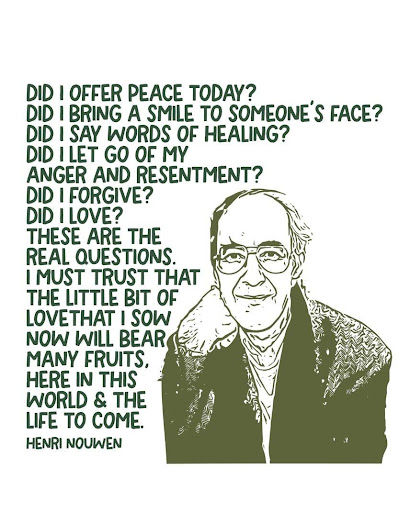
Henri Nouwen was a well-known Catholic priest who spent several decades teaching in subjects like pastoral care, social justice and community at places like Yale and Notre Dame.
But after these decades of teaching, he doubted himself and struggled to figure out how to actually live his life in a way that embodied the very things that he taught. Was it all worth it?
It was in his later life that he left his prestigious teaching positions and moved into a L’Arche community alongside people with intellectual and developmental differences. It was here that he discovered what it meant to prepare the way. To make room in himself to let the presence of Christ dwell within the beloved community. As one biographer notes: "Henri had always wondered what a Eucharistically centered community would be like, and now he had found one at L'Arche." In other words, all his teachings and theorizing about the way of Jesus became real once he brought himself into relationship with a community in which small miracles happened every day. This quote is attributed to Nouwen.
“Did I offer peace today? Did I bring a smile to someone’s face? Did I say words of healing? Did I let go of my anger and resentment? Did I forgive? Did I love? These are the real questions. I must trust that the little bit of love that I sow now will bear many fruits here in this world and the life to come.”
We will all face moments in our lives when the doubt creeps in. It’s not an IF, it’s a matter of WHEN.
It’s okay to wonder. It’s okay to question. Jesus also wants us to know it’s okay to shift our perception to the hope that lies in the small movements that unfold all around us every day.
Isaiah the prophet says these things in the midst of exile to people who felt they were at the end of their rope.
19 I am about to do a new thing; now it springs forth; do you not perceive it?
If Advent is about preparation of what happens in here, perhaps the work ahead of you is to notice where the new thing that God is trying to do in you. Can you try to perceive around you what hope looks like? Can you see the new and good things God is creating?
Can you give thanks with me for the laughter on parade floats and the generosity of food pantry supporters, while still refusing to turn away from the injustice that is happening in this country? Do you need to repent of the ways you’ve let anger consume you at the cost of ignoring the small mercies that stand on the sidelines? Can you believe with me that sometimes the new and good thing God is doing will happen long after we were there to plant the seed. Can you say with me that a trembling, fragile, doubting hope is still a hope.
This is the Advent preparation we all must work on. Because nothing these days comes easy. Ask hard questions. Say your fear out loud. Pay attention to the miracles unfolding all around you. And don’t let go of your trembling hope.
Grace and Peace,
Pastor Anna


Comments